
What Is a Thermal Shock Test?
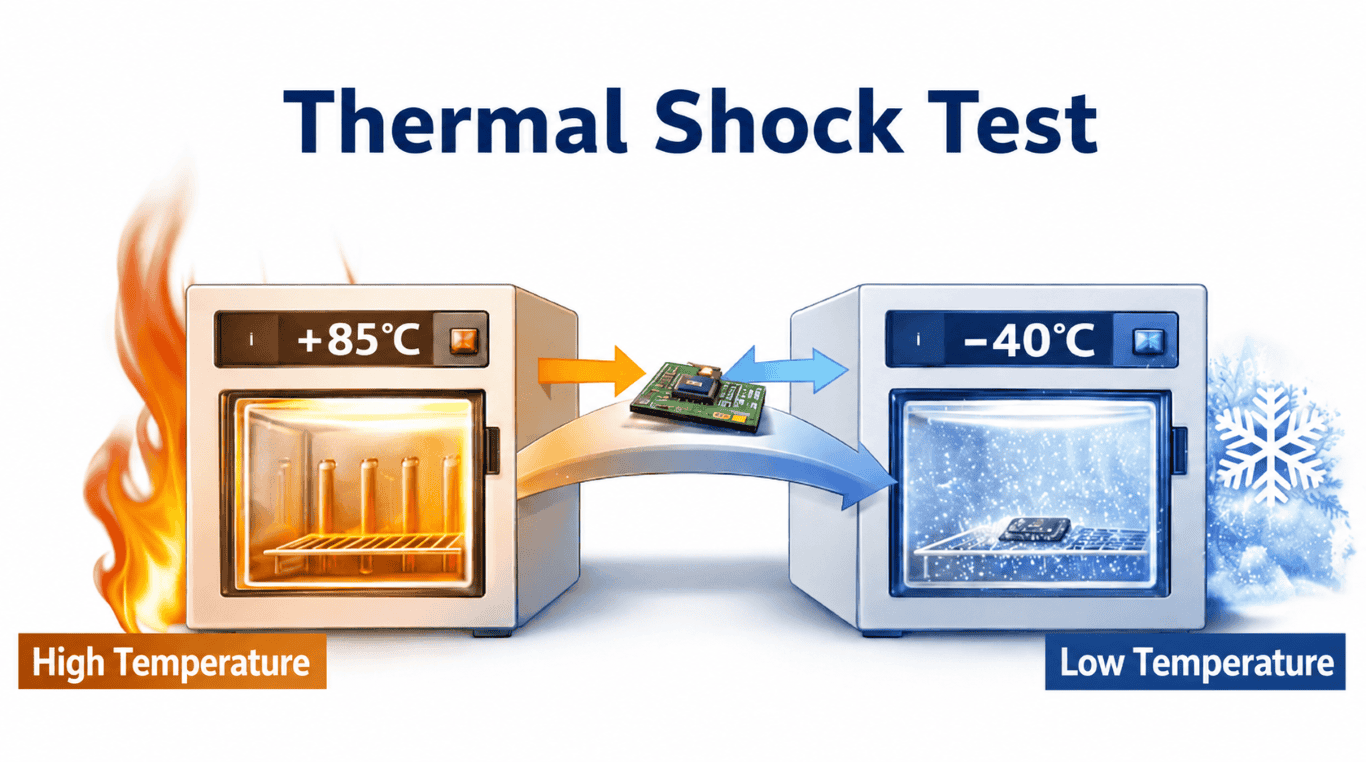 A thermal shock test is an environmental test that evaluates a product’s structural and functional durability by simulating sudden transitions between extremely low and extremely high temperatures within a very short time. Unlike temperature cycling, thermal shock simulates sudden temperature changes rather than controlled slow transitions. The goal is to reveal the damage mechanisms that sudden thermal stresses can produce on the product.
Sudden temperature changes can lead to serious damage, such as high stresses caused by differences in expansion between materials, cracks in solder joints, fractures in ceramic and glass components, loss of seal integrity in housings, and sudden loss of function in electronic systems. For this reason, thermal shock testing is critical for electronic boards and modules, defense and aerospace systems, automotive control units, and products containing glass, ceramic, or composite materials.
Thermal shock tests are usually carried out using two separate temperature zones: a hot zone and a cold zone. The product is held in one zone for a defined period and then transferred to the other zone within a very short transfer time.
This process is repeated for the defined number of cycles. One cold transition plus one hot transition is defined as a single thermal shock cycle.
| Thermal Shock | Temperature Cycling |
|---|---|
| Sudden temperature transition | Controlled transition |
| Very short transfer time | Defined ramp rate |
| Immediate damage detection | Long-term fatigue |
| High thermal stress | Gradual stress |
Thermal Shock Testing at OTAM
Thermal shock tests carried out at OTAM are performed in full compliance with national and international military norms, covering all procedures of the MIL-STD-810G Method 503.5, MIL-STD-810G Change 1 Method 503.6, and MIL-STD-810H Method 503.7 standards, between extreme temperature limits such as 150°C and -70°C, in our two high-capacity chambers with large internal volumes of 3024 L and 8000 L.