
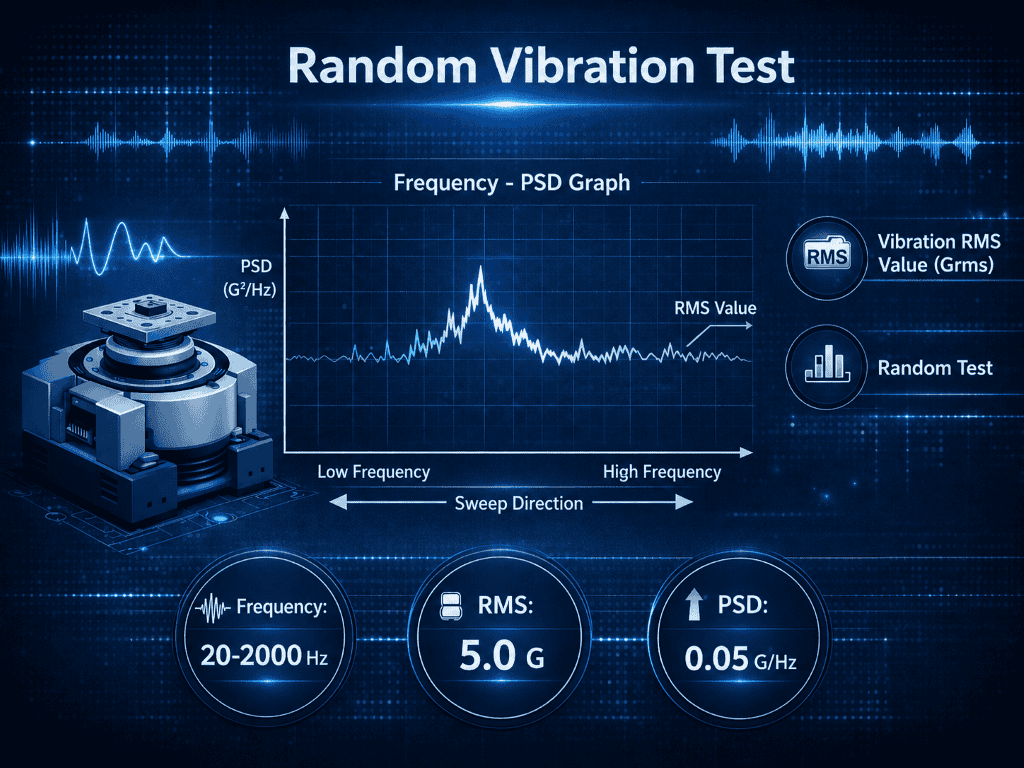
Random Test
Random vibration testing is a complex vibration profile that statistically represents real environmental vibrations, with many frequencies present at the same time. In real life, vibrations are usually irregular. For example, the vibrations produced when a vehicle engine is running, an aircraft is in flight, or a tracked vehicle is in motion are irregular and contain many frequencies at once. Random tests simulate this situation.
Unlike Sine tests, Random tests apply all frequencies in the defined range simultaneously. This excites multiple resonance points of the product at the same time, mimicking real-life scenarios in their most natural form. Random testing is one of the most critical methods for measuring the durability of an entire system under vibration, especially for electronic boards, sensitive components, in-vehicle hardware, and structural assembly parts.
Random vibration is typically expressed using a PSD (Power Spectral Density) curve. PSD describes the acceleration energy per unit frequency.
In this curve, the X axis represents Frequency (Hz) and the Y axis represents the Vibration level (g²/Hz). The curve is not flat; it rises and falls within specific frequency bands, indicating which frequency ranges expose the product to more energy.
The total vibration level (Grms) is obtained by integrating the PSD curve across the frequency band.
- PSD (Power Spectral Density): The intensity of Random tests is defined by Power Spectral Density (g²/Hz) rather than acceleration. This value shows how vibration energy is distributed across the frequency band.
- Statistical Approach: These tests are based on probabilities; the most extreme instantaneous peak values (Grms) the product may face are tested with this method.
Why Do We Run Random Testing?
In real life, vibrations are not regular but random. Random tests measure the product’s resistance against this uncertainty:
- Realistic Lifetime Simulation: Brings the complex vibration loads the product will face throughout its service life into the laboratory in the most accurate way.
- Simultaneous Resonance Effect: While each part vibrates in turn during a Sine test, all components are shaken at the same time during a Random test. This reveals the risk of parts colliding with or interacting with each other.
- Structural Integrity Validation: Tests the durability of complex systems, especially electronic components and connection points, under multi-directional stress.
Sine vs. Random: Which Should You Choose?
In fact, this is not a choice but a complementary process.
- With Sine Test, we identify the resonance points (weak spots) of the product.
- With Random Test, we verify whether the product maintains its durability and structural integrity under real-world conditions.
The Random tests performed in our laboratory are conducted in accordance with the most demanding profiles of international standards such as MIL-STD-810, RTCA DO-160, and ISO 16750. We make sure your product is ready for any “random” challenge it will face in the field before it is deployed.