Sine on Random (SoR)
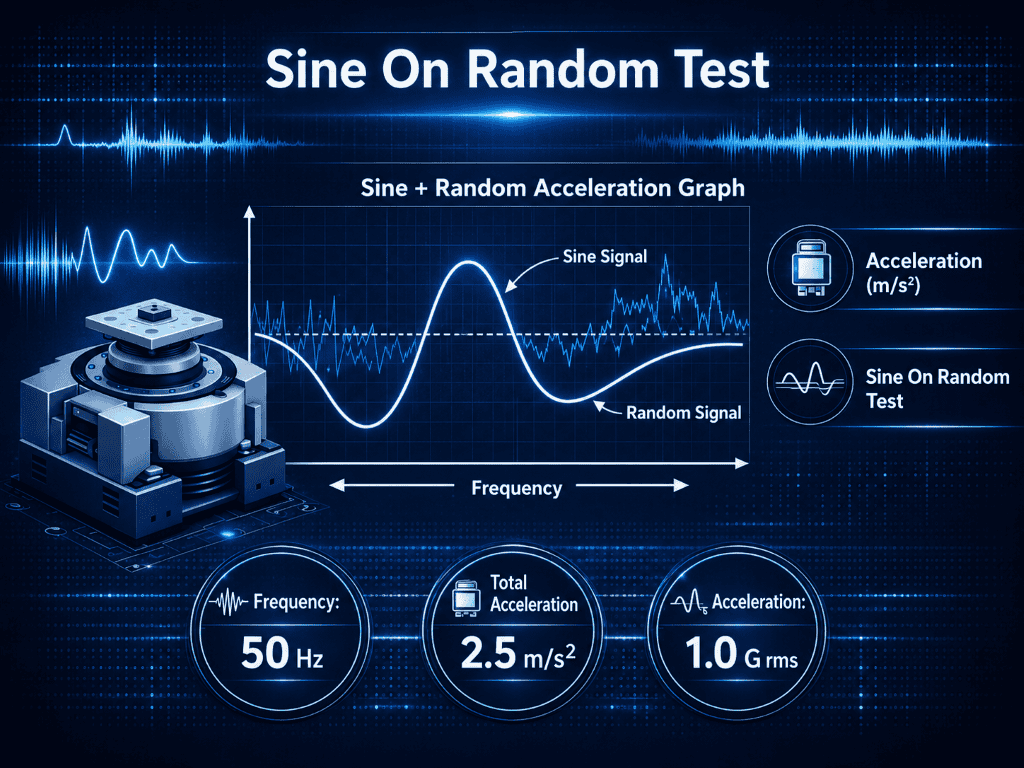
Modern engineering systems usually face complex stresses created by multiple sources at the same time, not by a single type of vibration. SoR (Sine on Random) is a hybrid test in which sinusoidal vibration at a specific frequency is superimposed on a random vibration profile.
In this method, the product is exposed to two different mechanical loads simultaneously:
- Broadband Random Vibration: Simulates the irregular, unpredictable vibrations of the product’s general operating environment (road conditions, wind resistance, etc.).
- Sine at a Specific Frequency: Adds the continuous, dominant “tonal” effect produced by rotating components inside the system (engine shaft, rotor, propeller).
Why Use SoR Testing?
Some environments cannot be fully reproduced with standard Sine or Random tests alone. SoR testing is particularly critical in cases such as:
- Realistic Engine Environment Simulation: Combining the engine’s general vibration (Random) with the specific frequency caused by piston or shaft motion (Sine).
- Aerospace and Defense Standards: Validation of systems exposed to both aerodynamic turbulence and mechanical rotation, such as helicopter equipment and jet engine components.
- Simultaneous Resonance and Fatigue: While random vibration shakes the entire system, the added sine wave drives the targeted component to its resonance limit, quickly revealing structural weaknesses.
Areas of Application
SoR testing is a standard requirement, especially in industries that demand high precision and safety:
- Aerospace: Helicopter airframe components and avionics systems.
- Automotive: Engine-mounted sensors, control units, and turbocharger systems.
- Industrial Machinery: Large-scale turbines and rotating industrial equipment.
Full Compliance with Standards
SoR tests carried out in our laboratory are managed with precision through advanced control systems, in full compliance with international defense and aerospace standards such as MIL-STD-810H and RTCA DO-160. With Sine Test, we identify the resonance points (weak spots) of the product.
- With Random Test, we verify whether the product maintains its durability and structural integrity under real-world conditions.
The Random tests performed in our laboratory are conducted in accordance with the most demanding profiles of international standards such as MIL-STD-810, RTCA DO-160, and ISO 16750. We make sure your product is ready for any “random” challenge it will face in the field before it is deployed.