
 What Is a Temperature Cycling Test?
 What Is a Temperature Cycling Test?
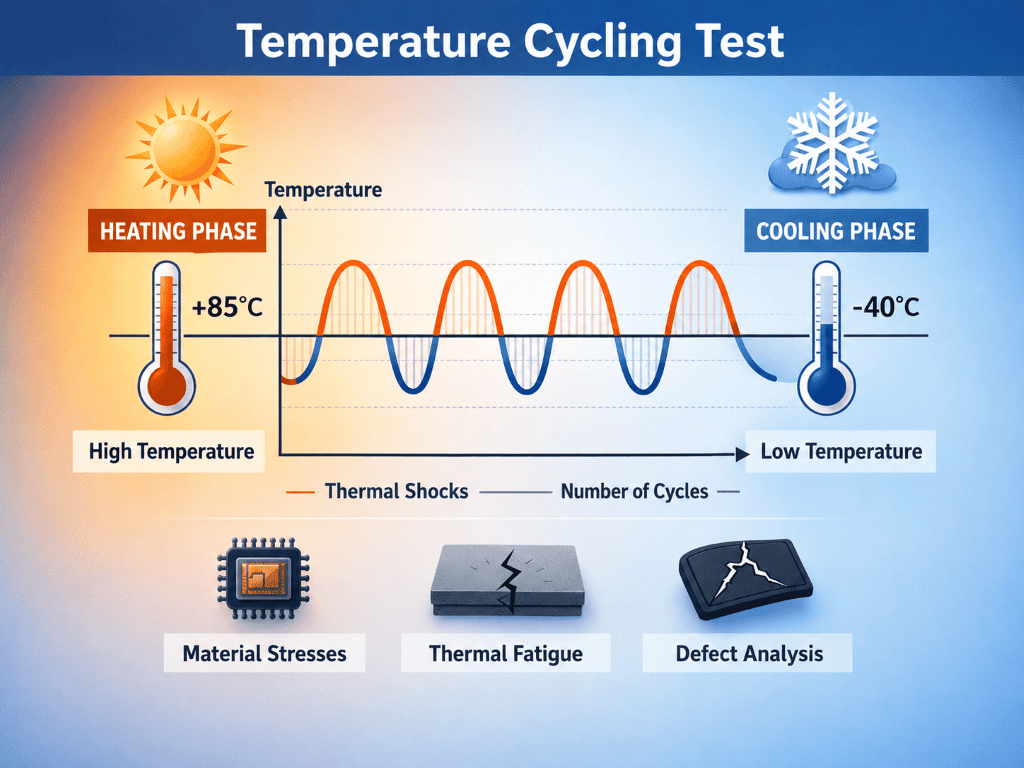
A temperature cycling test is an environmental durability test that simulates repeated thermal stresses by exposing the product alternately to low and high temperatures. The product is run through many cycles, transitioning between defined low and high temperature limits at a specific ramp rate (°C/min). The aim is to simulate the long-term effects of the temperature changes encountered in real use.
During temperature change, different materials expand at different rates. This can cause issues such as thermomechanical fatigue at solder joints, delamination between PCB layers, peeling of adhesives and coatings, damage to seals, cracks in housings, and damage to gaskets and sealing elements. For this reason, temperature cycling testing is critical for electronic boards (PCBs), automotive control units, defense and aerospace systems, and sealed-enclosure products.
In a temperature cycling test, the product is brought to the defined low temperature and held there for a specified dwell time, then transitioned at the defined ramp rate to the high temperature, where the dwell time is again applied. This cycle is repeated for the number of cycles defined in the standard. One transition from low to high temperature counts as a single cycle.
The main parameters controlled in a temperature cycling test:
- Lower and upper temperature limits (°C)
- Temperature change rate (°C/min)
- Dwell time (min / hours)
- Number of cycles
- Temperature gradient on the product
These parameters directly determine the severity of the test and the real-life conditions it represents.
The Difference Between Temperature Cycling and Thermal Shock
| Temperature Cycling | Thermal Shock |
|---|---|
|
|