
 Sine Test
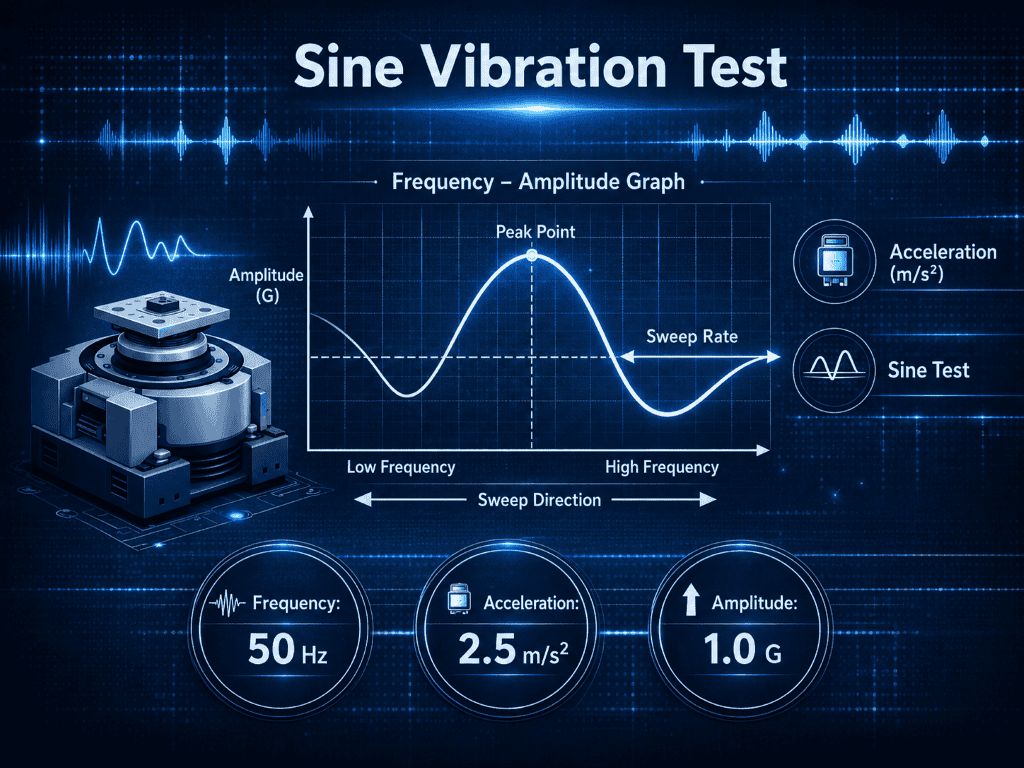 Sine Test
Sine (Sinusoidal) Vibration Testing is one of the most fundamental test methods, revealing the mechanical character of a product through controlled vibrations applied at a single frequency and amplitude. Understanding the mechanical loads a product will face throughout its operational life is critical to design reliability.
How Is a Sine Test Performed?
During the test, vibration is gradually increased or decreased starting from a specific frequency (this process is called Sweep). The test profile is built around three main parameters:
- Constant Displacement (Low Frequency): At low frequencies, the structure is observed while displacement is held constant within the shaker’s physical limits.
- Crossover Frequency: The critical threshold where the test transitions from displacement control to acceleration control.
- Constant Acceleration (High Frequency): At high frequencies, the test continues with the acceleration level (which has the highest damage potential) held constant.
Main Application Methods
Sine tests are applied in our laboratory using two main methodologies:
- Sine Sweep: By sweeping across a wide frequency band (for example 5 Hz – 2000 Hz), the product’s response across its entire operating range is measured.
- Sine Dwell (Resonance Hold): At identified resonance points, the product is held under fatigue loading for a defined duration. This is one of the harshest analyses used to find structural weaknesses and the “weakest link”.
Why Should You Perform Sine Testing?
Sine tests are far more predictable and controlled than random vibration tests. By testing the product at specific frequencies rather than with complex shocks, they let us clearly identify durability limits and weak points.
- Resonance Analysis: Identifies the frequency at which boards, cables, or critical components inside the product lose control.
- Accelerated Fatigue Testing: Years of fatigue loading are simulated in the laboratory in a short time, validating the product’s design life.
- Manufacturing and Assembly Quality: Assembly defects such as loose screws or weak solder joints are easily detected during the precise frequency sweep of Sine tests.
Knowing at which frequency your product vibrates “dangerously” prevents surprises in the field. Through Sine testing, applied across a wide range from defense to automotive, we test your structural safety.